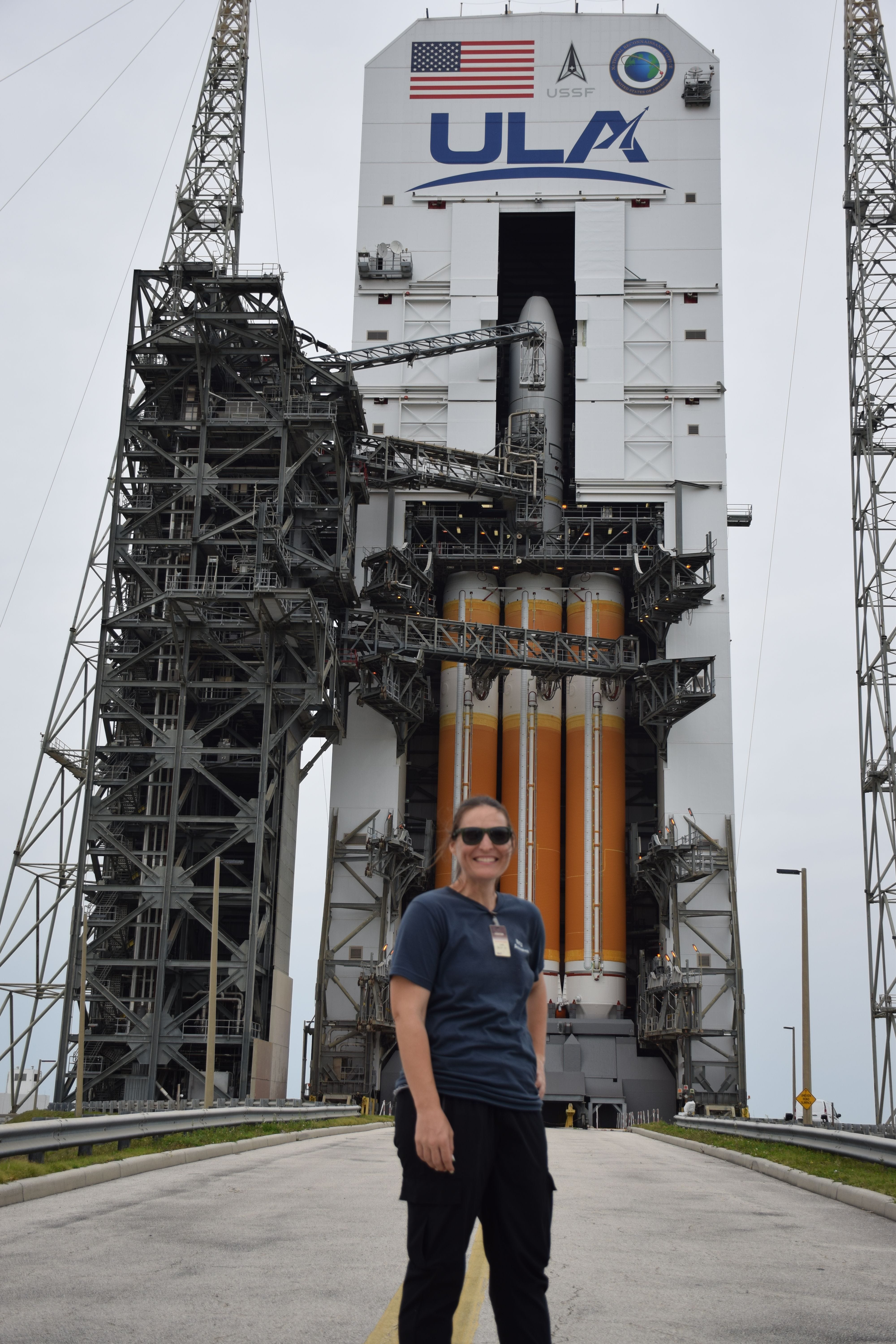

What are the long-term impacts of rocket launches on nearby communities?
Whitney Coyle, associate professor of physics at Rollins College, examines this.
Faculty Bio:
Whitney L. Coyle, PhD is an Associate Professor of Physics and Coordinator of the Pre-Engineering Program at Rollins College in Winter Park, Florida, where she serves as Chair of the college’s Department of Physics.
At Rollins, Coyle leads undergraduate-centered research exploring how sound is produced and measured in both musical instruments and large-scale systems like rocket launches. Her work connects fundamental physics with real-world acoustic environments while providing students with hands-on research opportunities.
She is the recipient of the 2026 R. Bruce Lindsay Award from the Acoustical Society of America (ASA), one of the world’s leading professional organizations in acoustics.
Transcript:
A rocket launch produces rumblings, vibrations, and high-intensity sound near the launch pad that can also travel to communities tens of miles away. My research focuses on how that sound propagates into communities near Cape Canaveral and how repeated launches may affect the local environment as launch cadence increases. Unlike aircraft noise, rocket launches contain strong low-frequency energy that can travel long distances and interact with homes and buildings in ways that are still not fully understood.
I work with a team of undergraduate physics majors using calibrated sound level meters, accelerometers, and ground vibration sensors to measure both the audible and very low-frequency components of rocket launches. These instruments allow us to study not just how loud a launch is, but how the sound and vibration interact with the environment. We are measuring how windows, walls, and structures respond to the low-frequency energy produced during launch.
These low-frequency sounds are especially important because they are not fully captured by traditional aircraft-based noise metrics currently used by the FAA. Those standards were developed for airplanes flying overhead on very different flight paths than modern heavy-lift rockets.
A major goal of this work is to improve understanding of how rocket launches are experienced in nearby communities. Residents along the Space Coast are overwhelmingly supportive of spaceflight and excited about continued growth in launch activity, but local planners and agencies currently have limited data available to evaluate long-term acoustic and vibration impacts.
This research is helping build the foundation needed to better characterize rocket-specific noise environments, evaluate potential structural response in nearby buildings, and eventually connect those measurements to how people perceive and respond to launches. As access to space continues to grow, understanding the broader environmental and community impacts of launch noise will become increasingly important and this work is helping lay the groundwork for that future understanding.
Read More:
[Rollins] - Coyle Receives Prestigious International Acoustics Award
[Rollins] - What It’s Like ... to Partner with Your Professor