

On University of Miami Week: Let’s rethink how discovery happens.
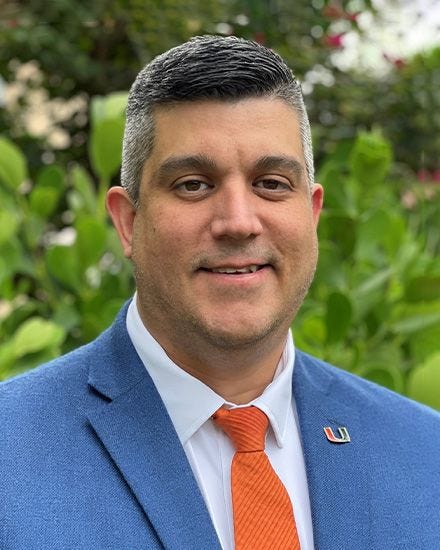
Alberto Caban-Martinez, Vice Provost for Research and Scholarship, examines how collaboration can help.
Faculty Bio:
Alberto J. Caban-Martinez is vice provost for research and scholarship at the University of Miami. He is also a tenured professor of public health sciences at the university’s Leonard M. Miller School of Medicine. As vice provost, he provides strategic leadership and oversight for the University’s research enterprise, advancing institutional priorities that promote research integrity, innovation, and global impact across its 12 schools and colleges. He directs initiatives that strengthen compliance and research governance, fosters interdisciplinary collaboration, and works with faculty, staff, trainees, and leadership to enhance research infrastructure and a culture of scientific excellence.
Transcript:
The men and women in the fire service go above and beyond to protect our communities. They give unconditionally in high stress and dangerous environments. Unfortunately, repeated exposure in those environments can increase health risks. For instance, fire investigators, a specialized group who analyze the root-cause of fires, report higher rates of bladder cancer. My research leads a national longitudinal cohort evaluating health outcomes in an effort to inform health and safety best practices for this group.
My team of multidisciplinary experts studies ways to reduce risk for fire service members by investigating evidence-based practices. Our ability to connect experts across disciplines, thoughts, and experiences positions us to solve this challenge.
We see this approach front and center in the University of Miami Laboratory for INtegrative Knowledge. Known as U-LINK, this university initiative fosters collaborative research teams to tackle complex problems. The U-LINK approach catalyzes, nurtures, and develops interdisciplinary and multidisciplinary research and science. We’ve seen remarkable success. To date, the program has elevated critical research, such as sustainable coastal protections, improved hurricane cone visualizations, and music therapy initiatives, into federally-funded, world-class efforts with global impacts.
We’re seeing societal issues continue to compound: first responder health and safety, climate change, extreme weather, energy demands, and more. Only when we’re willing to rethink the traditional research framework and not only embrace, but bolster collaboration, will we find solutions to our most vexing issues.
[Miami] - U-LINK


