


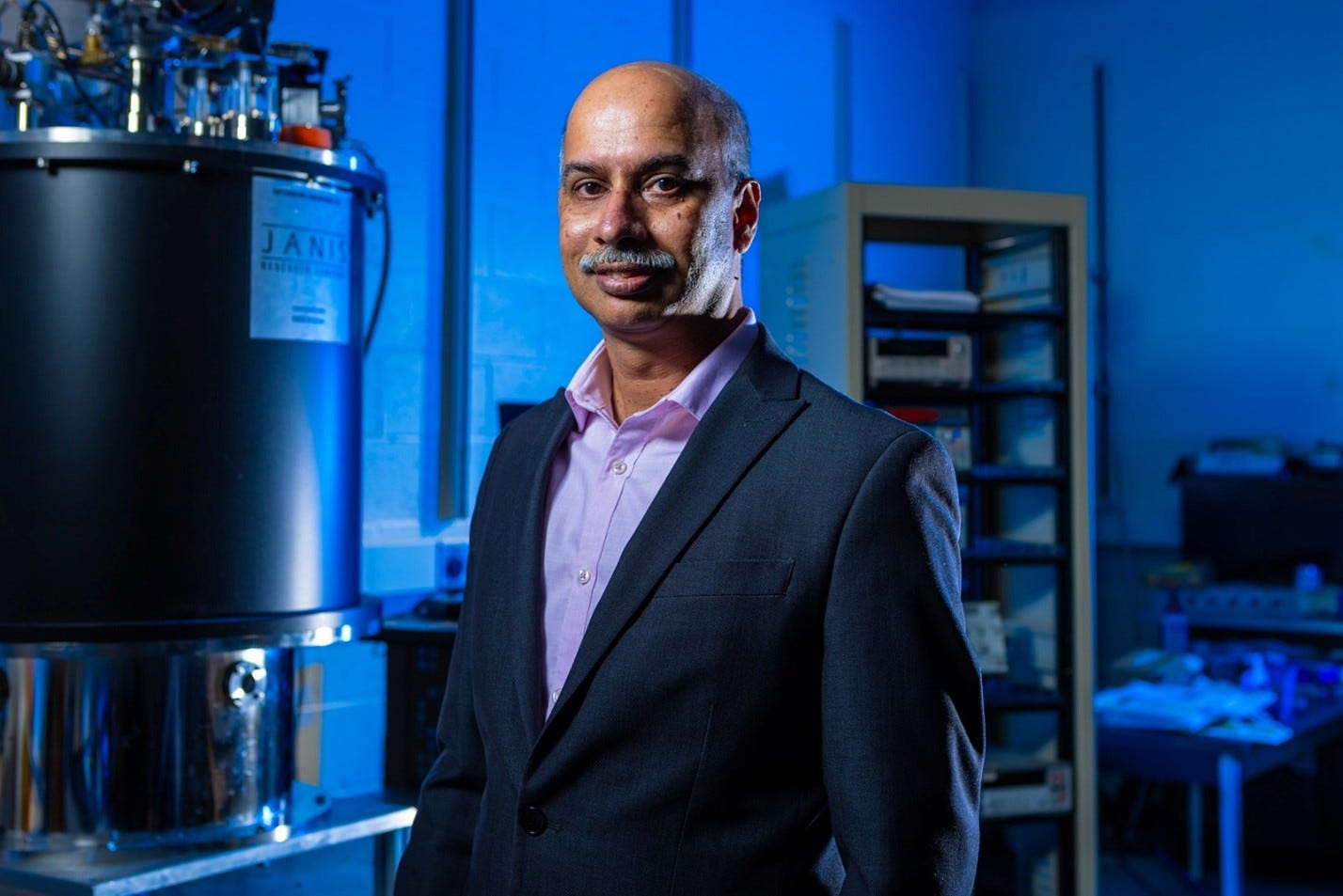
On University at Buffalo Week: Finding ways to reduce AI’s energy consumption can be crucial.
Sambandamurthy Ganapathy, professor of physics, explores how the human brain may have an answer.
Faculty Bio:
Sambandamurthy Ganapathy is a physicist who studies nanoscale materials and devices and how they relate to cutting-edge phenomena like superconductivity and resistive switching.
His experimental research group, which uses advanced nanofabrication techniques, designs and develops devices smaller than one micrometer that can explore the fundamental, microscopic mechanisms that dictate physical properties.
Ganapathy’s research examines electron transport in semiconductors and other atomic layers under ultra-low temperatures, high magnetic fields and other extreme physical conditions. It also investigates metal-insulator transitions, neuromorphic computing and superconductor-insulator transitions.
This work strives to unlock hidden quantum phenomena in novel states of matter which manifest when subatomic particles interact.
Transcript:
There’s nothing in the world as efficient as the human brain. It can store and process enormous amounts of information while using very little energy. That’s why my team and I are working on computing systems designed to mimic how the brain works.
This approach is called neuromorphic computing. It’s been around since the 1980s, but it’s gaining new attention as artificial intelligence makes computing more complex — and far more energy-hungry.
Computers and brains are already surprisingly similar. Computers have billions of transistors that switch on and off. Brains have billions of neurons that either fire signals or stay silent.
But there’s a major difference. In the brain, memory and processing happen in the same place. In traditional computers, they’re separated, so data has to constantly move back and forth. That takes a lot of energy. Neuromorphic chips aim to solve this by placing memory and processing much closer together, like the brain.
That’s where my research comes in. My team studies materials with unique quantum properties that could form the foundation of these new chips.
Neuromorphic computers won’t recreate consciousness, but they may solve problems in more human-like ways — especially when information is incomplete or uncertain.
In the near future, they’ll likely be used for specialized tasks, like self-driving cars. So don’t expect neuromorphic chips to power your smartphone anytime soon.


