


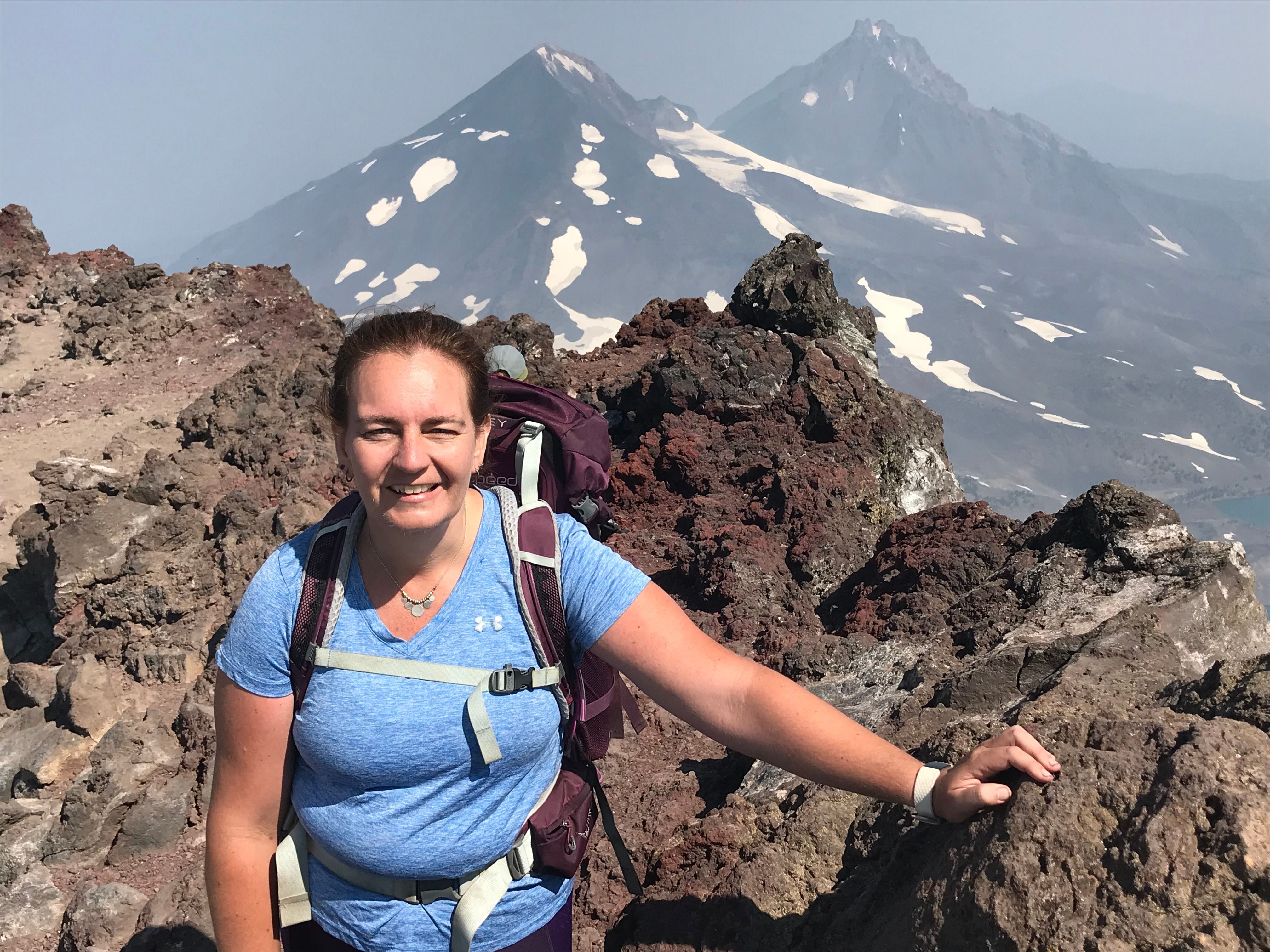
On Union College Week: How do we unravel the secrets of volcanoes?
Holli Frey, professor of geosciences, examines tiny crystals to gather clues.
Faculty Bio:
Holli Frey is a professor of Geosciences from Union College (NY). She studies volcanoes, trying to understand the plumbing systems beneath them, looking for clues as to how and why they erupt. She is particularly interested in mineral chemistry and chronology and uses a variety of analytical tools to address fundamental questions about magma evolution. She has active field-based projects in the Caribbean (St. Vincent and Dominica) and Central Oregon (Tumalo Tuff) and previously did work in the western Trans-Mexican Volcanic Belt and plutons in coastal Maine. She enjoys mentoring students, who are frequently co-authors on her publications. Her most recent work is on the eruptions of St. Vincent and she is a project partner of Dr. Jenni Barclay (University of Bristol) on a funded, collaborative grant, “Ex-X: Expecting the Unexpected (Understanding Dangerous Volcanic Transitions)”. This summer, Dr. Frey will take several students to Dominica, continuing to explore the eruptive history of the island. Dr. Frey received her B.A. in geology from Franklin and Marshall College and her PhD in geosciences from University of Michigan, supported by a National Science Foundation Graduate Research Fellowship.
Transcript:
In early 2021, the volcano La Soufrière in St. Vincent in the Caribbean rumbled to life after more than 40 years. Thick lava slowly oozed out at the summit, not a real threat to the 16,000 people living in its shadow.
Then, in April, everything changed. The shaking beneath the volcano shifted, prompting an evacuation. In less than 24 hours, powerful explosions began, sending ash high into the atmosphere. For two weeks, more than 30 explosions rocked the island, transforming the landscape and destroying more than 1000 homes.
So, what happened inside the volcano during that sudden transition?
To find out, we turned to the crystals locked inside the rocks that erupted in the first 48 hours. It was the smallest crystals – called microlites – that were key to understanding the volcano’s behavior. The microlites are like time capsules; they preserve clues about where magma has been and what it experienced on its journey to the surface. As these tiny crystals formed, they caused the magma to become more gas rich, increasing the pressure past a tipping point which caused the explosions.
What we found in the microlite chemistry tells a story of magma moving through two very different environments on its way to the surface.
The first crystals formed deep underground, more than fifteen kilometers beneath the volcano, where magma sat under intense pressure and water-rich conditions. Those crystals were carried upward, survivors from deep in the volcanic plumbing system.
The next series of microlites didn’t come from depth however. They crystallized as the magma was moving more quickly to the surface, after the initial throat clearing first blasts that destroyed the lava dome.
By reading the record preserved in the tiny crystals, we can better understand how quiet dome-building eruptions suddenly become explosive and hopefully improve how we anticipate hazards at active volcanoes.
Read More:
[Lyell Collection] - Petrology of the explosive deposits from the April 2021 eruption of La Soufrière volcano, St Vincent: a time-series analysis of microlites
[Union] - Frey Awarded NSF RAPID Grant
[U.S. National Science Foundation] - Award Abstract # 2132566 RAPID: The effusive to explosive transition of La Soufrière, St. Vincent: Insights from petrology and hygrometry


