
Revisiting the history of the National Alliance of Black Feminists provides a new lens through which to view intersectionality.
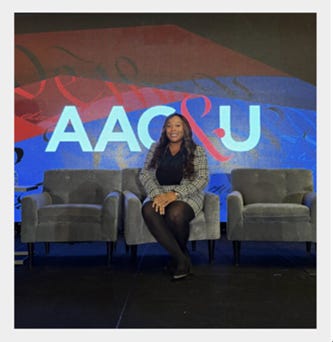
Victoria Fields, doctoral candidate and instructor of record in Communication at the University of Illinois Urbana-Champaign, explores this.
Faculty Bio:
Victoria T. Fields is an award-winning educator and scholar. She is currently a doctoral candidate and instructor of record in the Department of Communication at the University of Illinois at Urbana-Champaign. Victoria is also a graduate assistant for instructional design at the John N. Gardner Institute for Excellence in Higher Education, where she crafts content for Gardner Institute academies and co-leads faculty workshops on topics such as engaged pedagogy, moral imagination, and civic engagement in the classroom. Victoria’s research focuses on the rhetoric of Black women, archival rhetorics, and social movements. In 2025, Victoria was the recipient of the K. Patricia Cross Future Leaders Award from the Association for American Colleges and Universities (AAC&U). Her work has been published in Volume 11 of the Eastern Michigan University McNair Scholars Journal and Bloomsbury Press, along with co-authorship in the International Review for the Sociology of Sport, the Sociology of Sport Journal, and Political Communication.
Transcript:
As Black women were excluded from leadership in both the Black Freedom Movement and mainstream white feminism, they turned to one another to form independent organizations and advance critiques of racism, sexism, and capitalism—grounding their intersectional oppression within their lived experiences.
One of the organizations that arose was the National Alliance of Black Feminists, or NABF, a nonprofit organization, active between 1976-1981 and headquartered in Chicago, Illinois. NABF was committed to achieving full equality for Black women in America. NABF was led by founder and executive director Brenda Eichelberger, who was a guidance counselor in the Chicago Public Schools.
NABF used media to promote and generate critical awareness of Black women’s intersectional oppression. Their efforts are seen in public appearances on the Phil Donahue Show, published essays in the Chicago Defender, women’s news for a Change…and Essence Magazine. In addition, NABF led, organized, and facilitated consciousness-raising sessions, conferences, and assertiveness training for Black women. These rhetorical strategies functioned as key sites of NABF’s engagement in political education and organizing, yet the NABF has been understudied and undervalued within dominant historical and feminist scholarship.
Revisiting the NABF allows us to uncover the depth and complexity of their rhetorical strategies and contributions to what we now recognize as “intersectionality.” NABF’s work rested on the premise that Black feminism is infused with humanism, linking their identity as Black women to humanity, one that has historically been subject to surveillance, regulation, and violence. They recreated the Bill of Rights through a Black feminist lens—insisting that dignity, agency, and liberation are inseparable.
While the NABF was short-lived, the Alliance reframed ephemerality not as failure but as an intentional and responsive space for Black feminist organizing. The NABF’s legacy offers a living template of constructive engagement guiding our collective journey toward liberation.