


Tornadoes do not only occur on Earth; they also happen in space. How do we predict them?
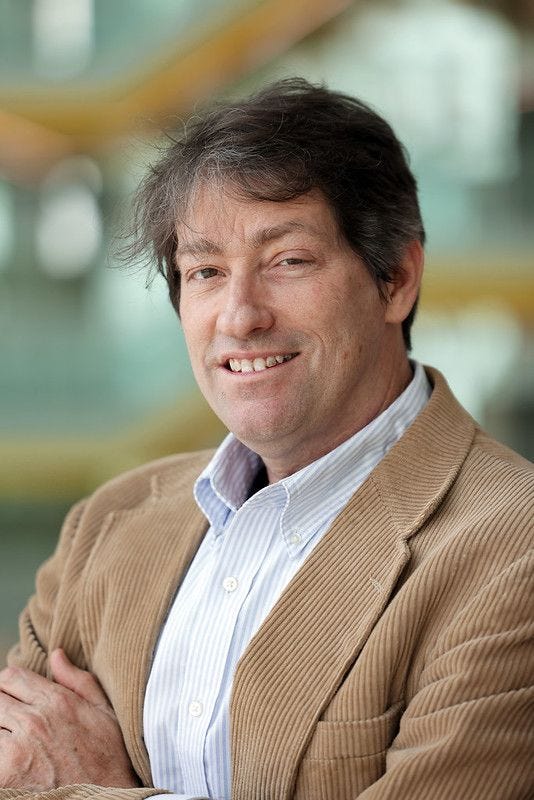
Chip Manchester, C. Robert Clauer Collegiate Research professor of Climate and Space Sciences and Engineering at the University of Michigan, looks into this.
Chip Manchester is a research professor of climate and space sciences and engineering at the University of Michigan. His research focuses on the movement of solar plasma and magnetic fields through the solar system.
On Earth, a combination of weather stations and computer simulations help scientists predict how dangerous storms form and where they will move. With the forecasts, local communities can take safety precautions to prepare for dangerous storms.
Scientists do the same for space weather, which originates at the Sun first as the solar wind, a soup of charged particles and magnetic fields that flows from the Sun and fills the solar system. On top of this relatively calm breeze, there is extreme space weather, driven by solar eruptions called coronal mass ejections. CMEs, which leave the Sun at high speed and expand to enormous size comparable to the Sun-Earth distance. These ejections can travel from the Sun to Earth in less than two days, and if they possess southward-pointing magnetic fields, they can trigger geomagnetic storms. Such storms create beautiful aurorae but can also damage electric grids and disrupt GPS-navigation systems, such as the Google Maps app on your smart phone.
Predicting when coronal mass ejections might hit Earth, as well as their shape, size, density and magnetic field orientation, can help people prepare for severe space weather. But mMy colleague collaborators noticed that some geomagnetic storms occur without predicted Earth-bound eruptions. To better understand the discrepancy, our modeling team joined the effort to created a computer simulation of a coronal mass ejection moving through the solar system. The simulation had a spatial resolution 30 times higher than standard models along the eruption’s path, which allowed us to see patterns in the solar wind too small for previous simulations, while simultaneously viewing the larger eruption.
We found that several intense, tornado-like spirals in the magnetic field called flux ropes, separated from the larger eruption when it plowed through a slow stream in the solar wind. Some of these tornadoes had southward-pointing magnetic fields that could trigger geomagnetic storms, even though the magnetic fields in the nearby eruption were oppositely oriented. Our results demonstrate the need to watch how solar eruptions move through space and monitor for small, but concerning, events.
But to directly see and make reliable forecasts of these flux ropes, we need to monitor the solar wind from several vantage points, and we currently rely on probes at a single location between the Earth and Sun called L1. To address this problem, the mission team, led by Mojtaba Akhavan-Tafti, is developing a constellation of four satellites, one of which will be propelled beyond L1 by a solar sail. This will help us look out for smaller storm systems that we might otherwise miss.
Read More:
[Michigan Engineering] - We need a solar sail probe to detect space tornadoes
[The Astrophysical Journal] - High-resolution Simulation of Coronal Mass Ejection–Corotating Interaction Region Interactions: Mesoscale Solar Wind Structure Formation Observable by the SWIFT Constellation


