
Taxpayers will be footing the bill for reduced SNAP benefits for older adults.
Colleen Heflin, professor of public administration and international affairs at Syracuse University, explains why.
Faculty Bio:
Colleen Heflin is a professor of public administration and international affairs. She is also a senior research associate in the Center for Policy Research and a research affiliate in the Lerner Center for Public Health Promotion and Population Health. She has served as associate dean of the Maxwell School of Citizenship and Public Affairs and chair of the Public Administration and International Affairs Department.
As a research and policy scholar for over twenty-five years, Heflin is regarded as a national expert on food insecurity, poverty and social policy. Heflin’s research has helped document the causes and consequences of food insecurity, identify the barriers and consequences of participation in nutrition programs, and understand the changing role of the public safety net in the lives of low-income Americans.
Heflin has published over 80 research articles, and her work has appeared in leading journals such as the American Sociological Review, Demography, Social Problems, Health Affairs, Medical Care, and the Journal of Policy Analysis and Management. Her research is regularly funded by the National Institutes for Health, U.S. Department of Agriculture, the Robert Wood Johnson Foundation and the Russell Sage Foundation. From 2012-2017, Heflin was supported by a five-year award from the U.S. Department of Health and Human Service as Family Self-Sufficiency and Stability Research Scholar to explore how multiple program participation affects vulnerable families’ well-being.
Heflin has experience engaging with federal policymakers, providing expert testimony before Congress, providing technical assistance to states working to improve access to food and nutrition assistance programs, and working with county agencies to redesign their Supplemental Nutrition Assistance Program (SNAP) application process. She founded the University of Missouri Federal Statistical Research Data Center and Missouri Population, Education and Health Center. She received the W. Richard Scott Award for Distinguished Scholarship from the American Sociological Association in 2014.
Transcript:
Nationally, one in five of all SNAP recipients are over age 60. Until now, older adults were not subject to work requirements like their younger counterparts. But provisions in President Trump’s One Big Beautiful Bill limit SNAP benefits for adults ages 60 to 64 without a dependent or disability to three months within a 36-month period unless they can show that they are spending 80-hours per month in work, training, or volunteer activities.
Work requirements for programs like SNAP and Medicaid do not lead to increased work but instead result in fewer people receiving benefits. Nonetheless, an even more onerous version of work requirements were expanded for other groups as well, including adults 55-59, those with children who reach age 14, veterans, the homeless, and foster care youth.
Reducing older adults’ access to SNAP is particularly shortsighted given the strength of the evidence regarding SNAP’s effectiveness at reducing food insecurity, which already affects 1 in 10 adults over age 60 nationally. Since food insecurity is associated with poor health, the ability to consistently afford nutritious food is considered important enough that the Veterans Health Administration, among others, now regularly screen for food insecurity.
Because SNAP participation is associated with $1,400 in health care savings per year, reducing access will increase health care costs in the long run. And the increased health care costs will largely be shouldered by taxpayers since the federal government covers medical costs after age 65 through Medicare and many SNAP participants qualify for Medicaid.
It is already too difficult for older adults to obtain SNAP benefits. Currently, just over one in two adults age 60 and older who qualify for SNAP participate. Increasing work requirements is a step in the wrong direction and will decrease SNAP participation, increase food insecurity, and make it harder to cope with diabetes and hypertension, increasing the public costs of Medicaid and Medicare.
Read More:
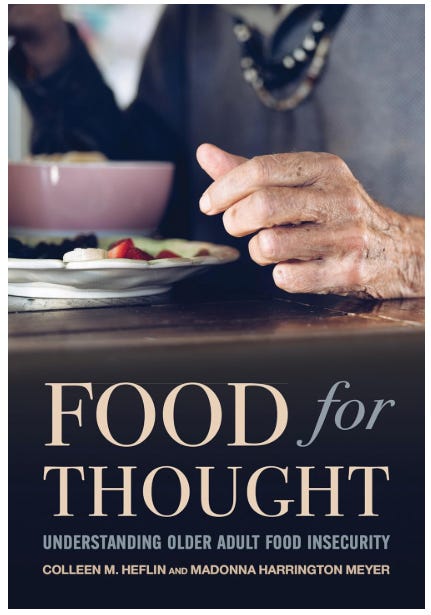
[Russell Sage Foundation] - Food for Thought: Understanding Older Adult Food Insecurity