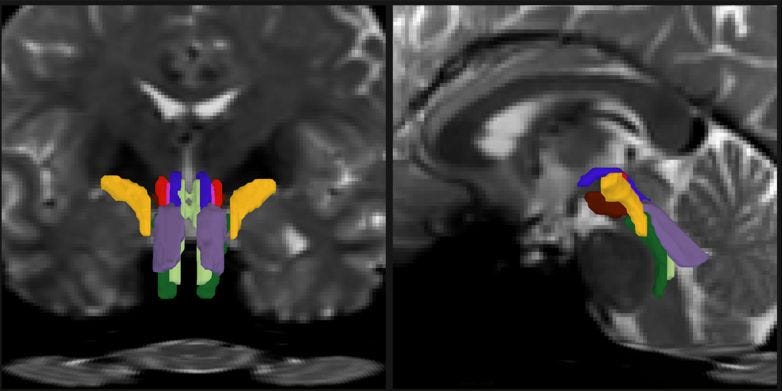

Brainstems are hard to image because of their size and density, but is that about to change?
Emery N. Brown, professor of neuroscience at the Massachusetts Institute of Technology, says yes.
Faculty Bio:
Emery N. Brown, M.D., Ph.D. is the Edward Hood Taplin Professor of Medical Engineering and Computational Neuroscience at MIT in The Picower Institute for Learning and Memory; the Warren M. Zapol Professor of Anaesthesia at Harvard Medical School; and an anesthesiologist at Massachusetts General Hospital. Dr. Brown is a neuroscientist-anesthesiologist-statistician whose research has contributed toward understanding how anesthetics act in the brain. In his statistics research he has developed signal processing algorithms to solve important data analysis challenges in neuroscience. For his work he received the National Medal of Science in January 2025.
Transcript:
Don’t sleep on the importance of your brainstem. This part of your brain is a vital conduit between your body and the rest of the brain. The signals that flow through bundles of nerve fibers there govern essential functions such as consciousness, sleep, breathing, heart rate and motion.
While we know that the brainstem is absolutely crucial and that damage there can present patients with major problems, we haven’t had good ways to image and keep track of the health of its fiber bundles for reasons including how small and densely packed they are.
But earlier this year, my colleagues and I, led by my graduate student Mark Olchanyi, developed a new way to clearly see brainstem fiber bundles in diffusion MRI imaging. The Brainstem Bundle Tool uses AI to analyze MRI images from patients, enabling us to track the size and structural integrity of eight distinct nerve fiber bundles.
In the study we showed that the tool could reliably spot different effects on fiber bundles from Alzheimer’s disease, Parkinson’s disease, multiple sclerosis and traumatic brain injury. Mark even used the tool to retrospectively look at the bundles in a patient who had been in a coma for seven months before recovering. He was able to show how the bundles were healing during that time.
We are hopeful that this innovation, developed at MIT, Harvard and Massachusetts General Hospital can transform the brainstem from being something of a mystery into a brain structure essential for understanding normal brain physiology as well as brain diseases and injury.
Read More:
[The Picower Institute] - Opening a new window on the brainstem, AI algorithm enables tracking of its vital white matter pathways
[Picower People] - Emery N. Brown, innovative neuroscientist, statistician and anesthesiologist earns National Medal of Science
[MIT News] - 3 Questions: Emery Brown on improving anesthesia with neuroscience