



Can the light reflected from a leaf reveal the health of a tree?
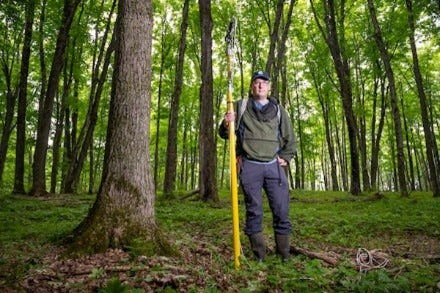
Nathan Swenson, professor of biological sciences and the Gillen director of the Environmental Research Center at the University of Notre Dame, looks for clues in the canopy.
Faculty Bio
Nathan Swenson is a professor of biological sciences and the Gillen Director of the University of Notre Dame Environmental Research Center. The goal of the research conducted by his group is to leverage information regarding intra- and inter-specific variation in tree performance to understand and predict the past, present, and future distribution of forest biodiversity.
Transcript:
Forests often look healthy — right up until they aren’t. By the time trees show visible signs of drought, disease, or pest damage, it can already be too late to prevent widespread decline. So, one of the biggest challenges in ecology is detecting stress early enough to protect forest health. Field surveys give us detailed information, but they’re too slow and labor-intensive to cover large areas. Genomic tools can reveal the activity of genes involved in drought responses or defense against pathogens, but those approaches are costly and difficult to scale. In our recent research, we asked a different question: can the light reflected from a leaf reveal what’s happening inside it at the genetic level? Leaves reflect light in specific wavelengths depending on their chemistry and condition. We measured leaf reflectance and paired it with gene expression data for genes tied directly to water stress and plant defense. For hundreds of genes we analyzed, specific wavelengths of reflected light were strongly associated with gene activity. That means we may be able to detect early molecular responses to stress—before trees visibly decline. By linking reflected light to gene expression, we move closer to monitoring forest health at landscape scales, using airborne or satellite sensors that measure light reflectance from the canopies of trees to identify forest declines before they reach a tipping point.
Read More:
[Notre Dame News] - How light reflects on leaves may help researchers identify dying forests


